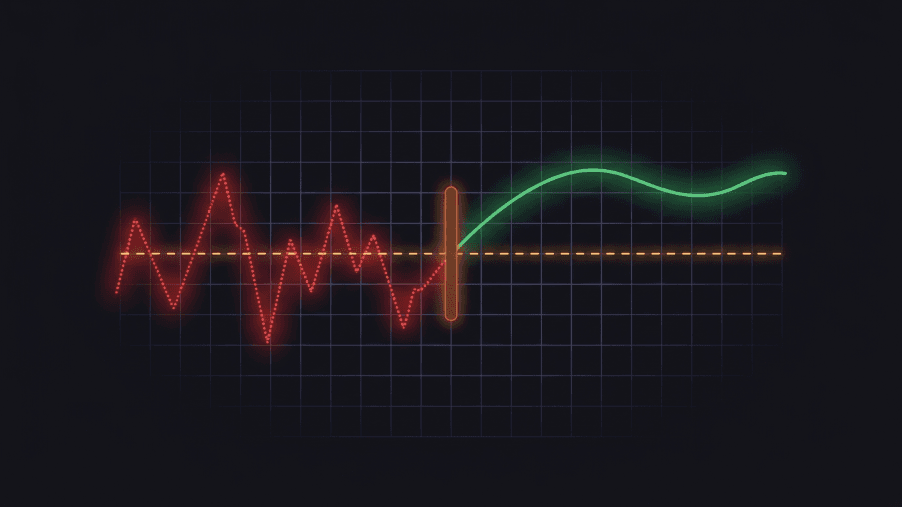
AI citation volatility is short-term variation in whether, or how often, a page appears as a cited source across repeated comparable queries, with no directional trend: present Monday, absent Tuesday, back Thursday. It means the page is a marginal candidate, close enough to be picked sometimes but not clearly the best source, so the engine's probabilistic selection flips between it and a competitor. Volatility is not noise to ignore and not decay to refresh; it is a signal that the page needs to become the unambiguous pick. The fix is to widen the margin: a sharper direct answer, more specificity than the rival, a stronger entity, cleaner extraction. The free scan shows the per-engine standing; the Content Creator closes the gap that keeps you marginal.
Anyone who has tracked AI citations has seen the flicker: the page is cited, then it is not, then it is, and nothing changed. The instinct is to dismiss it as randomness, and the randomness is real, but it is not the whole story. Engines select probabilistically among candidates, and a page that flickers is one whose probability sits near the threshold, sometimes above, sometimes below. The flicker is the engine telling you how close the contest is, and that you are not winning it decisively.
What decides it is the citation margin, the gap between your page's standing and the next candidate's: wide margin, stable citation; narrow margin, volatility. The work is widening it.
Why do citations flicker?
Because selection is probabilistic and your page sits near the line. For any query, an engine has several candidate sources that would answer acceptably, and it picks among them with some randomness, weighted by how well each fits. A page that is clearly the best fit is picked nearly every time; a page that is roughly as good as two others is picked roughly a third of the time, and that third shows up as flicker. Small differences tip the choice run to run: a slightly different phrasing of the query in the engine's fan-out, a retrieval that surfaced a competitor first, a freshness signal that nudged the weights. None of it is a verdict on your page. All of it says the margin is thin.
How is volatility different from decay?
By the slope. Volatility is fluctuation; decay is a directional decline over time. Decay is a citation with a downward trend, once stable and now sliding, which calls for a refresh. Volatility is a citation with no trend, oscillating around a mean, which calls for strengthening. They need opposite fixes, so misreading one as the other wastes the effort: refreshing a volatile page changes nothing about its margin, and strengthening a decaying page misses that the field moved. The five citation patterns give the full taxonomy; the practical rule is to plot frequency over repeated queries and read the shape before choosing the fix.
What widens the margin?
The same four properties that decide selection, pushed past the rival. A sharper direct answer: the volatile page usually answers adequately and the competitor answers slightly more directly, so move the answer to the first hundred tokens and state it without hedging. More specificity: a concrete figure, a named mechanism, a worked example the rival lacks, because engines break ties toward the source that adds something. A stronger entity: a verifiable author and organization tip trust-weighted selection your way when content is otherwise equal. And cleaner extraction: sections that stand alone, so the passage the engine lifts is coherent without the rest of the page. Each moves the probability up; together they take a page from a coin flip to the default.
How do you diagnose which lever is thin?
Run the page and its target phrase through Diagnose mode in the Content Creator for one credit. The gap list shows the sub-questions the phrase demands that the page covers weakly, which is almost always where the rival edges you, and the per-engine breakdown from the free scan shows whether the flicker is on every engine (a content margin) or on the trust-weighted ones only (an entity margin). Then Rewrite the page for four credits to sharpen the answer and fold in the missing specificity, keeping every fact, and re-scan. A free account's 10 credits covers the diagnose-and-rewrite cycle on your most valuable flickering page with credits to spare.
How do you confirm the fix worked?
The frequency curve, not the edit. Keep querying on the same cadence after the rewrite and watch the oscillation settle: a stabilized citation shows as the page appearing on most runs instead of half, with the variance shrinking. That takes a few weeks of readings, because a single post-fix query is as unreliable as a single pre-fix one, and the readings only compare if query wording, engine, date window, and market or location are held constant; otherwise the flicker you see is your own noise. Volatility is only ever visible in the pattern, so the confirmation has to be too.
Publishing more content on the topic, on the theory that volume settles things, is the common response to a flickering citation, and it usually makes the flicker worse by splitting the site's authority across several near-equal pages, none of which becomes the clear pick. Volatility is not a volume problem. It is a margin problem on one page, and the fix is to make that one page decisively better than the rival, not to surround it with siblings that compete with it.
Sources
- Google, AI features and your website: how AI surfaces select among candidate sources. developers.google.com
- Princeton, GEO: Generative Engine Optimization: research on the factors that shift generative-engine selection. arxiv.org/abs/2311.09735
- Website AI Score, five citation patterns: the taxonomy separating volatility from decay and ghosting. View article
- Website AI Score, AI citation decay: the opposite pattern and its opposite fix. View article
- Website AI Score, information gain: how engines break ties between near-equal sources. View article